Connect to your logger over WiFi or USB, download and analyze your sessions, keep its firmware current, and turn a lap into a finished video — natively on your Mac.
Not just downloads — firmware, settings, configurations, live channels and the screen it boots to, all from here.
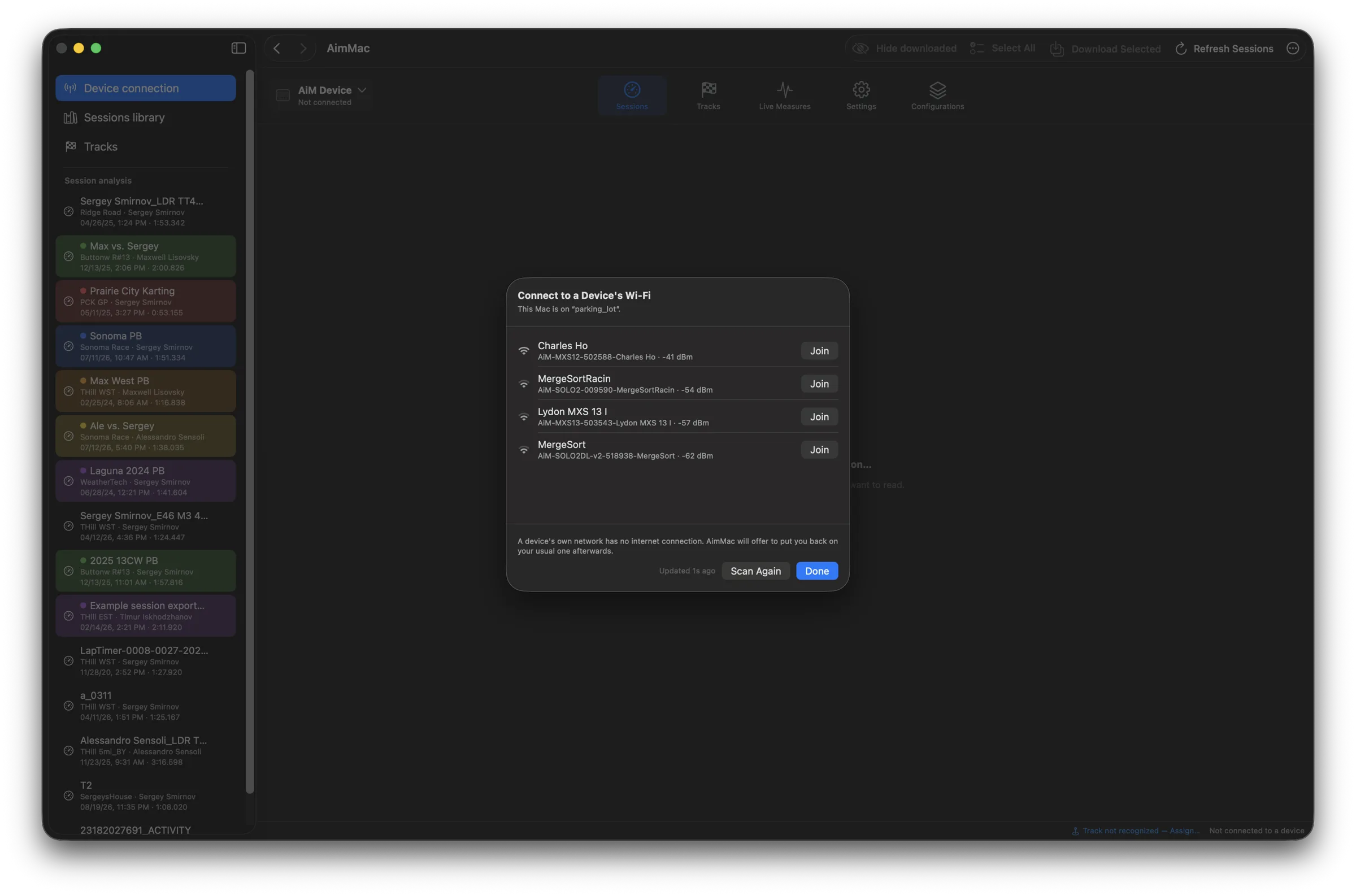
AimMac finds the AiM loggers in range and names each one, so you pick a device rather than decoding a network name. Join it in a click, swap to another whenever you like, and get put back on your usual network when you're done.
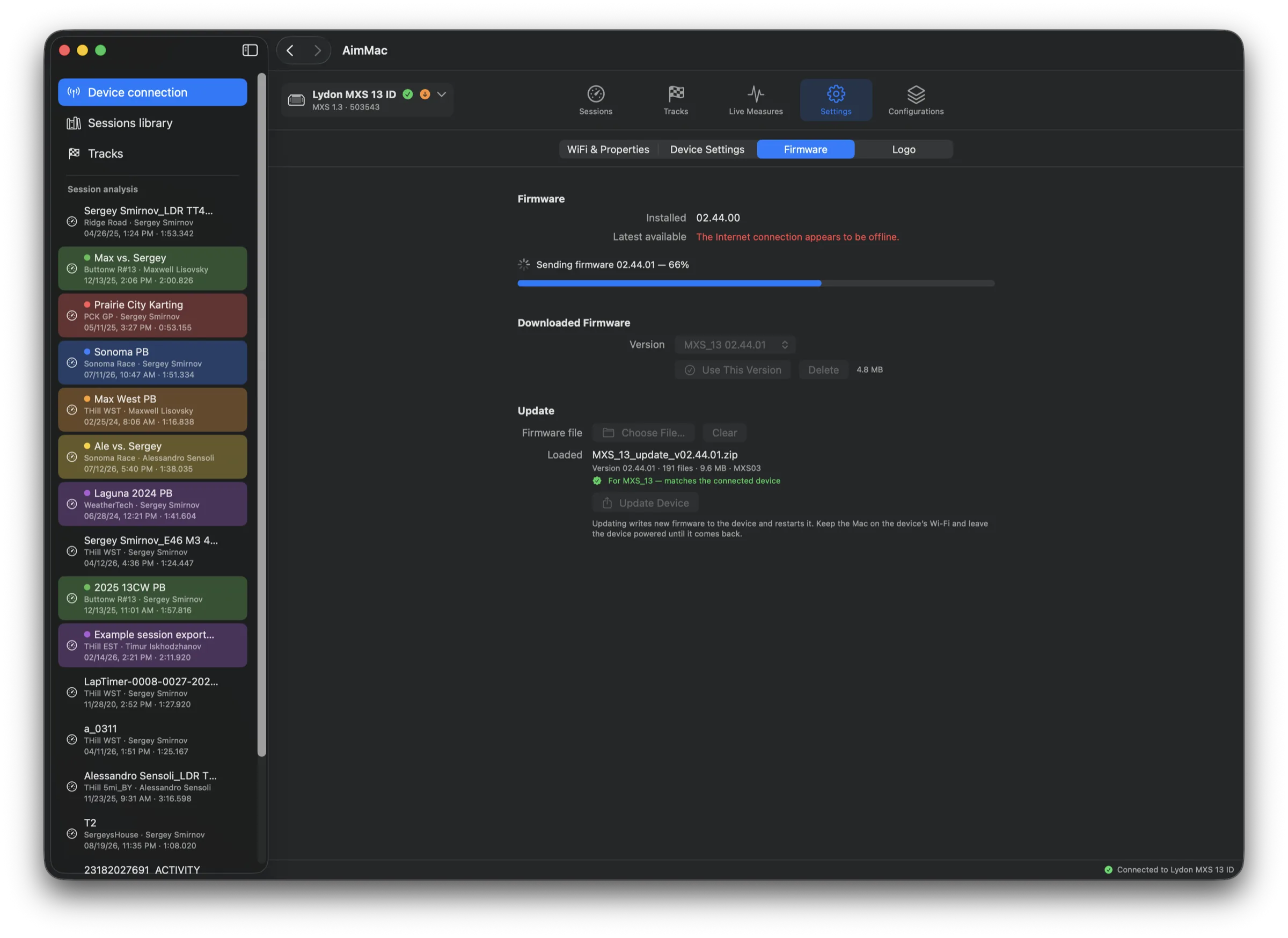
See what's installed, pick a version AiM has published, and send it. AimMac checks the file matches your device first, and flags the device when a newer version is out. Downloads are kept, so you can fetch firmware while you're online and install it once you're on the device's network.
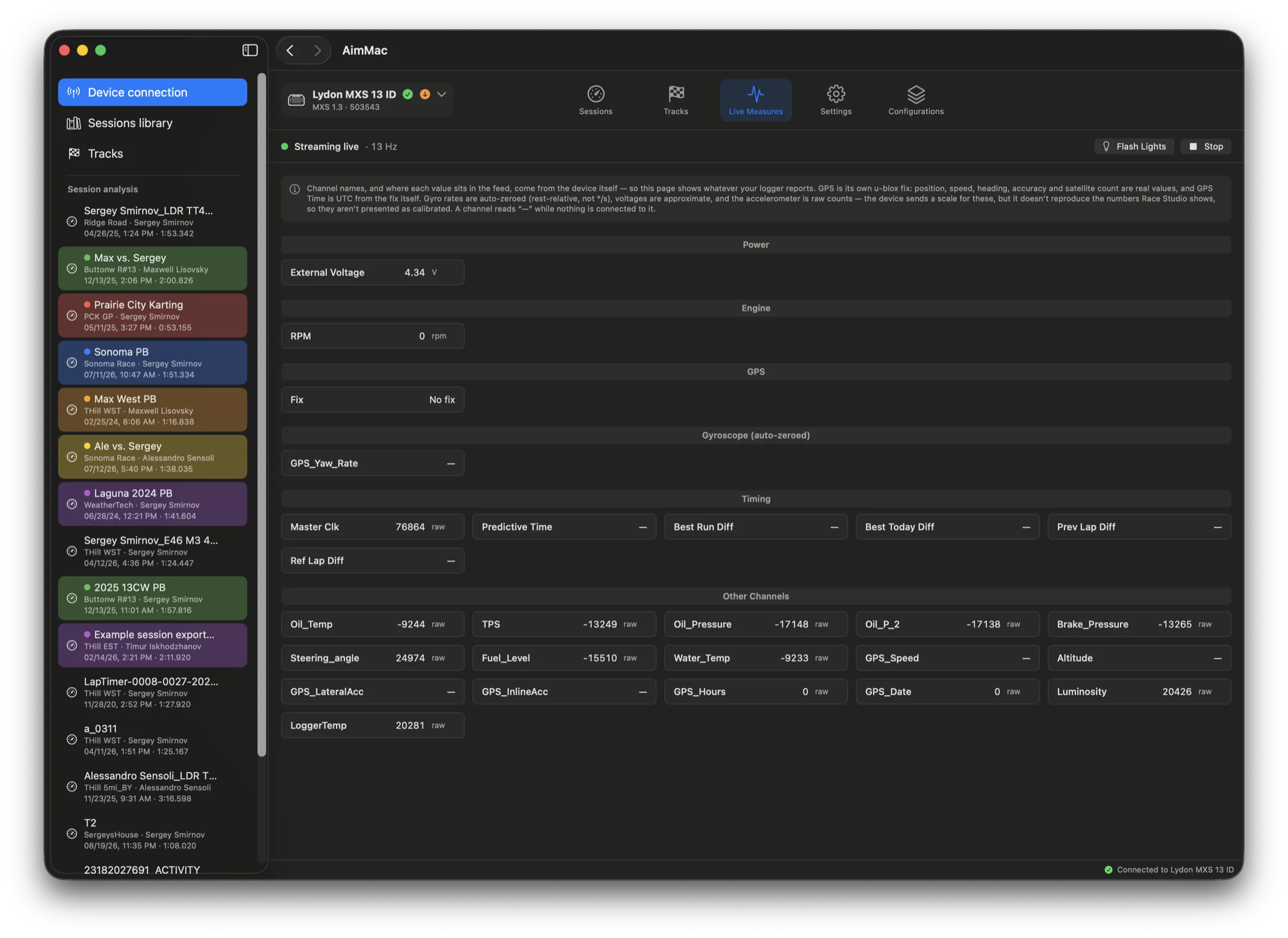
GPS fix, RPM, voltages, temperatures, pressures, the accelerometer and gyro — streaming live while the device sits on the bench, so you can prove a sensor works before you go out on track.
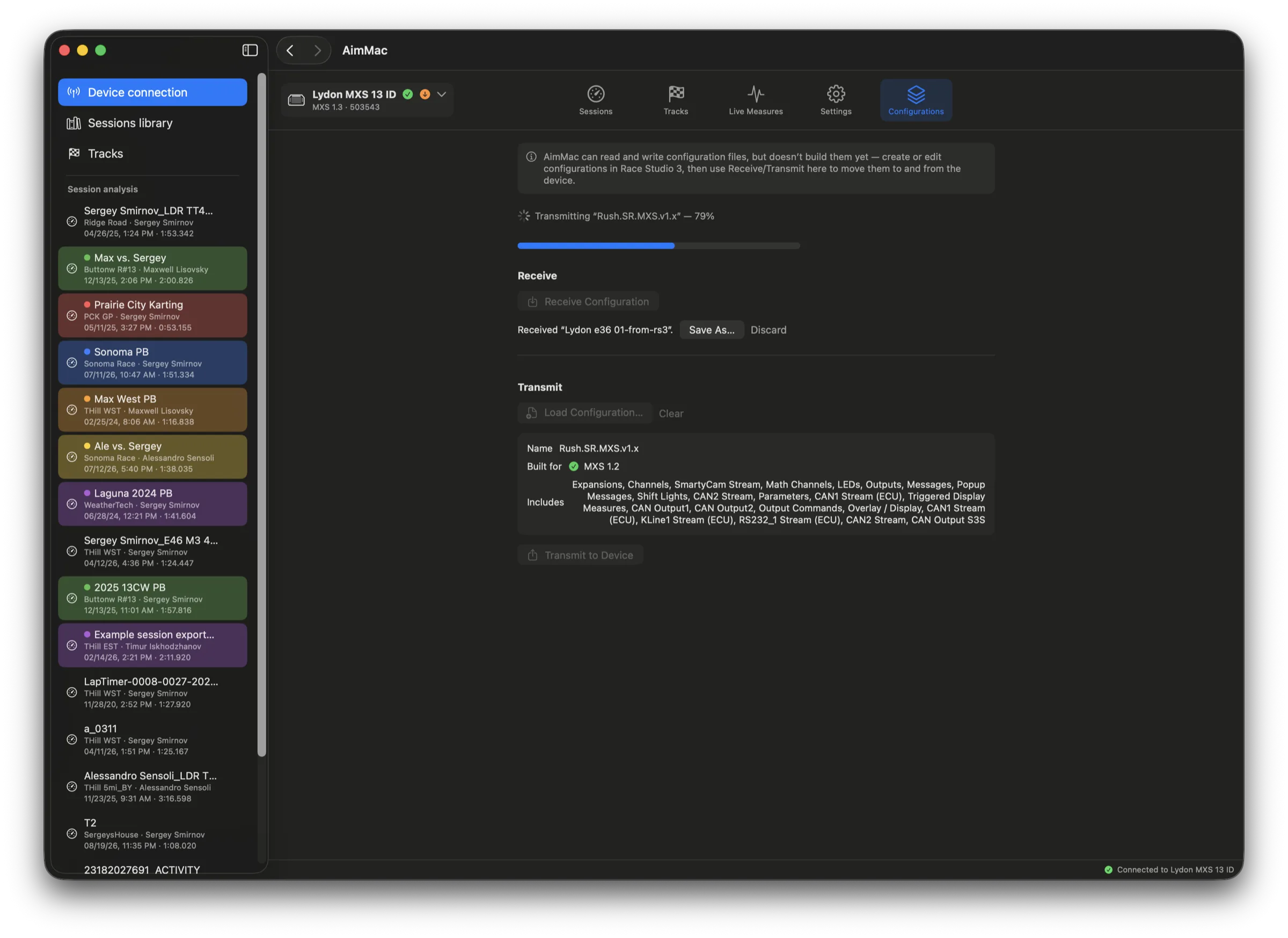
Build your configurations in Race Studio 3, then transmit them to the logger from AimMac — and receive whatever is already on it, to keep a backup or copy a setup to a second device. Device name, WiFi mode, date and time format, predictive lap reference and the rest of the on-device options are set from the same place.
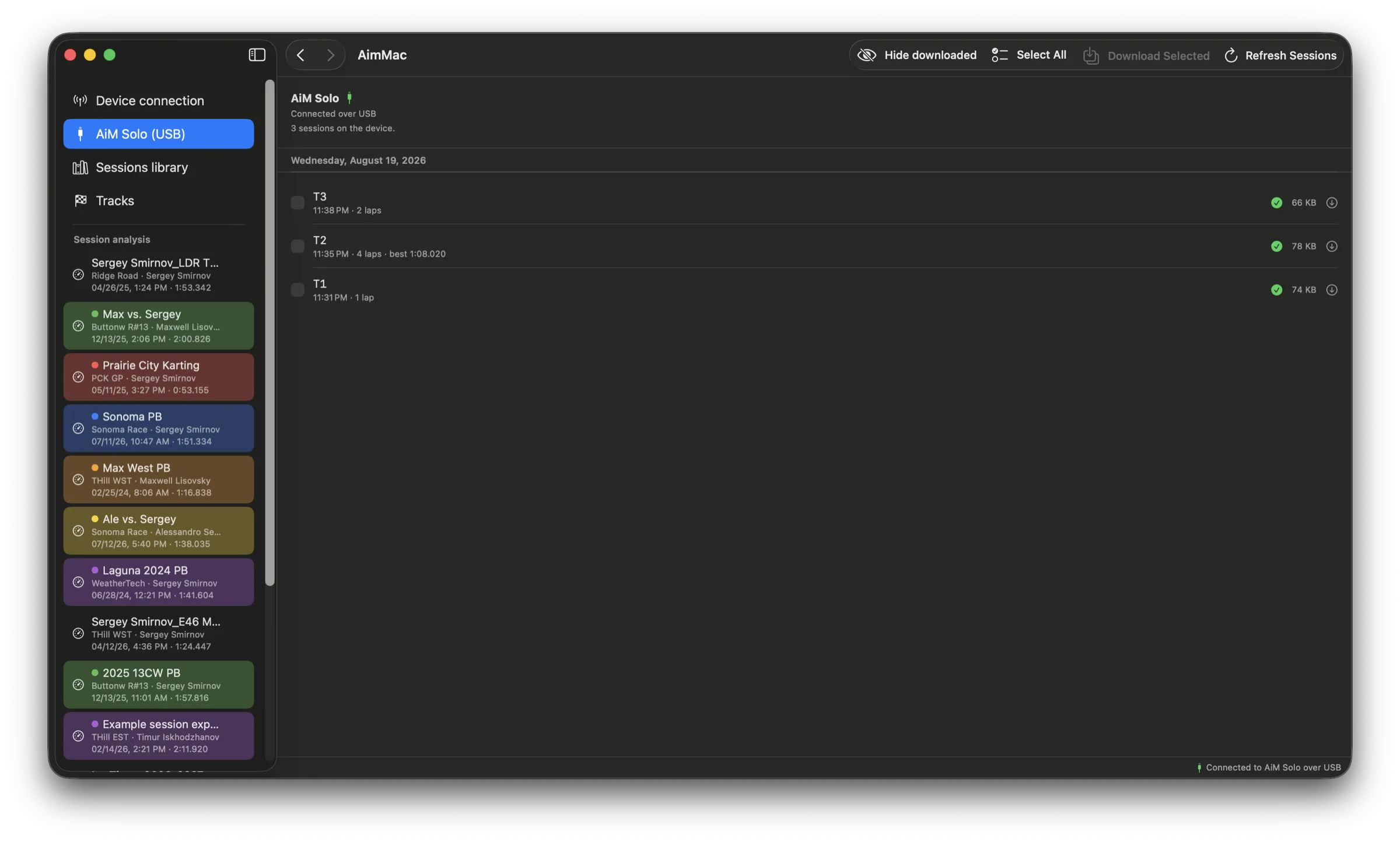
The loggers with no WiFi at all plug straight in. AimMac lists what's on the device and downloads it — and takes the laps from the start/finish line stored on the device itself, so they match what the logger timed instead of being guessed from the trace.
Send any image to the device as its boot logo — and preview it on the dash before you commit.
See what's loaded, spot the ones that are out of date against your library, and send new ones across.
Model, serial and firmware are read from the device itself — including loggers that report no name at all.
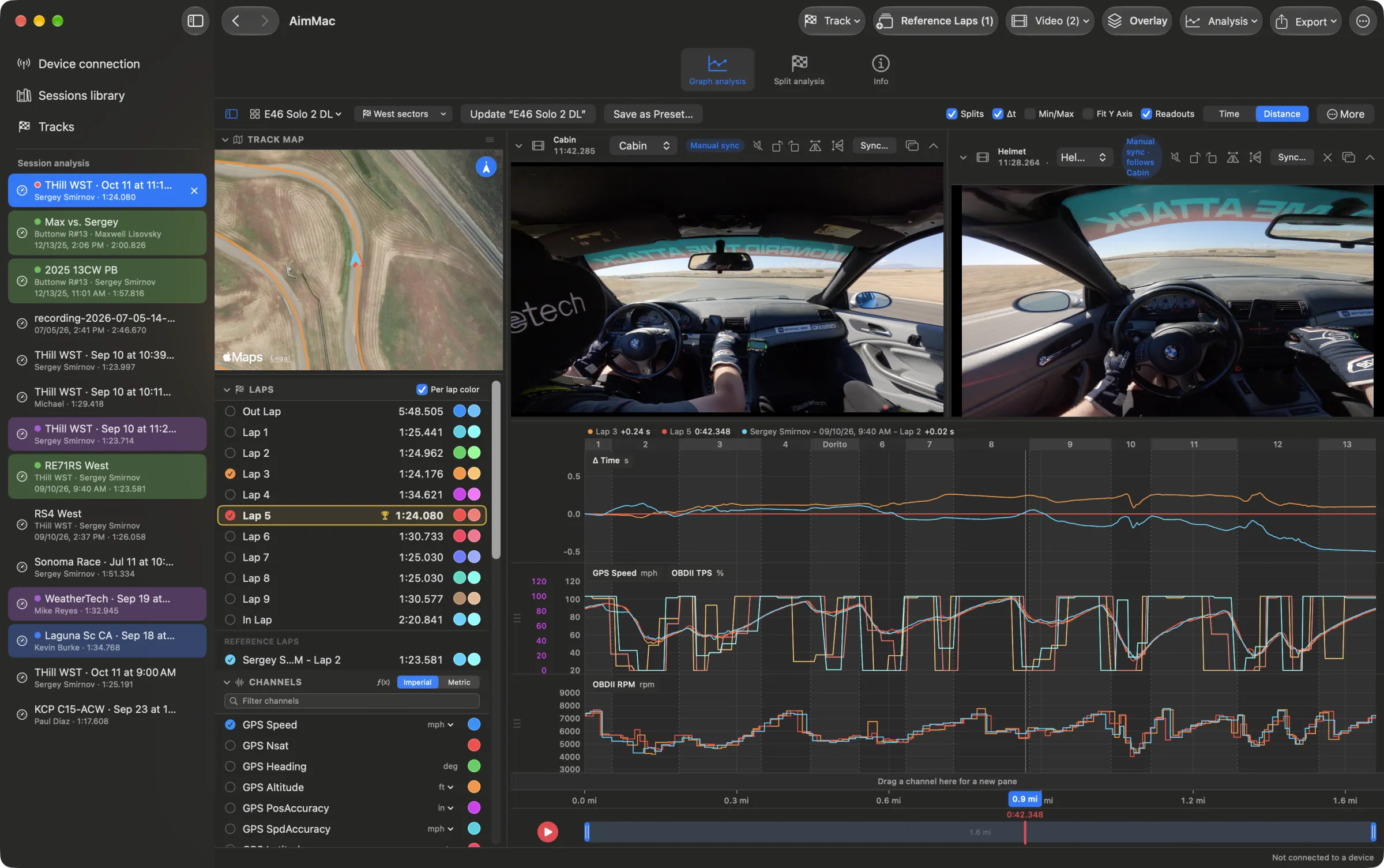
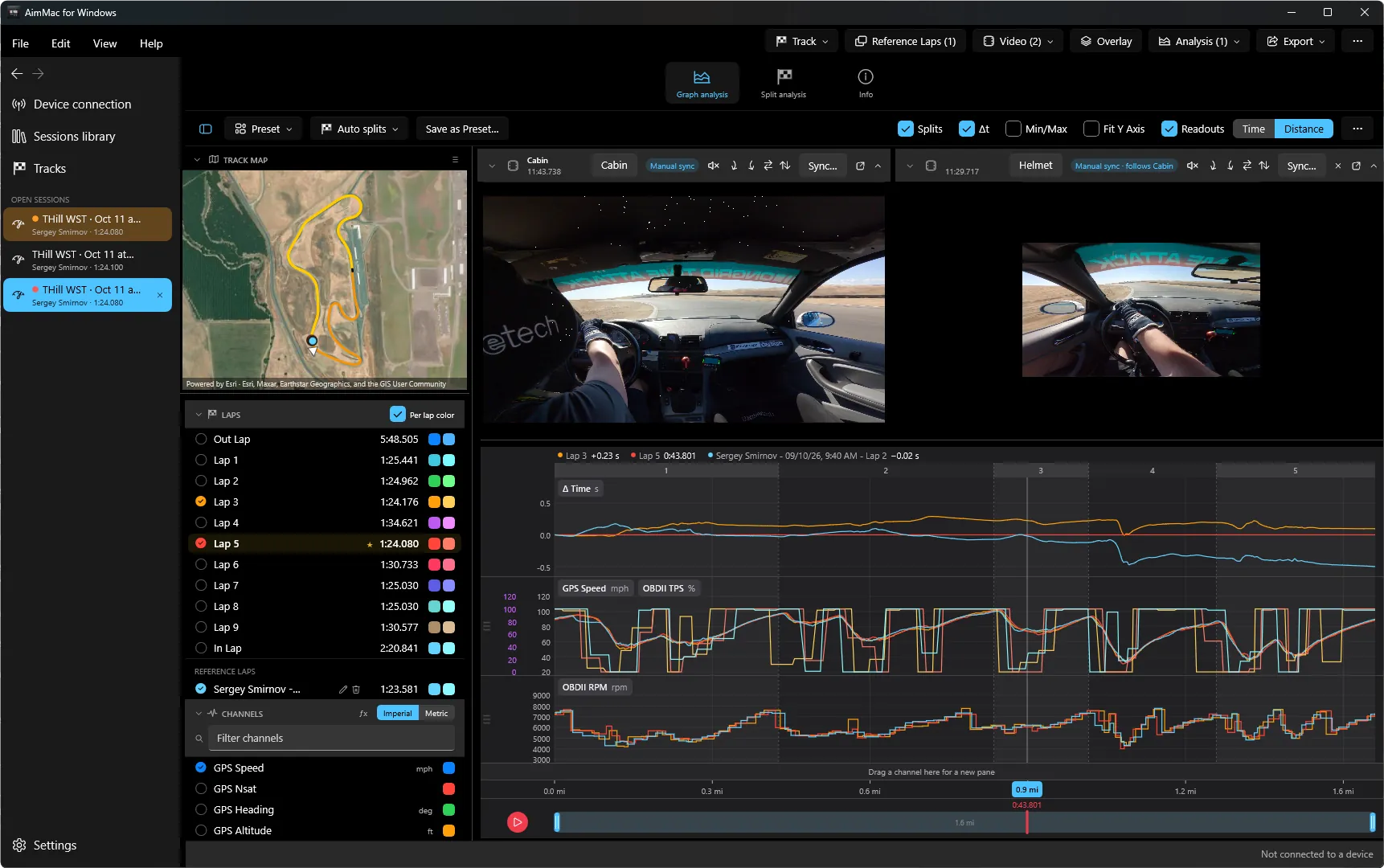
Every channel your logger records, laid over every lap you want to compare — on a time axis or a distance one.
Each lap in its own color, one crosshair reading them all, and a satellite map that chases your cursor through the data. Plot against distance and two laps stay aligned corner for corner instead of drifting apart. A time-difference curve above the traces shows where every lap is gaining and losing against the one you're chasing. Save a layout as a preset and reuse it everywhere.
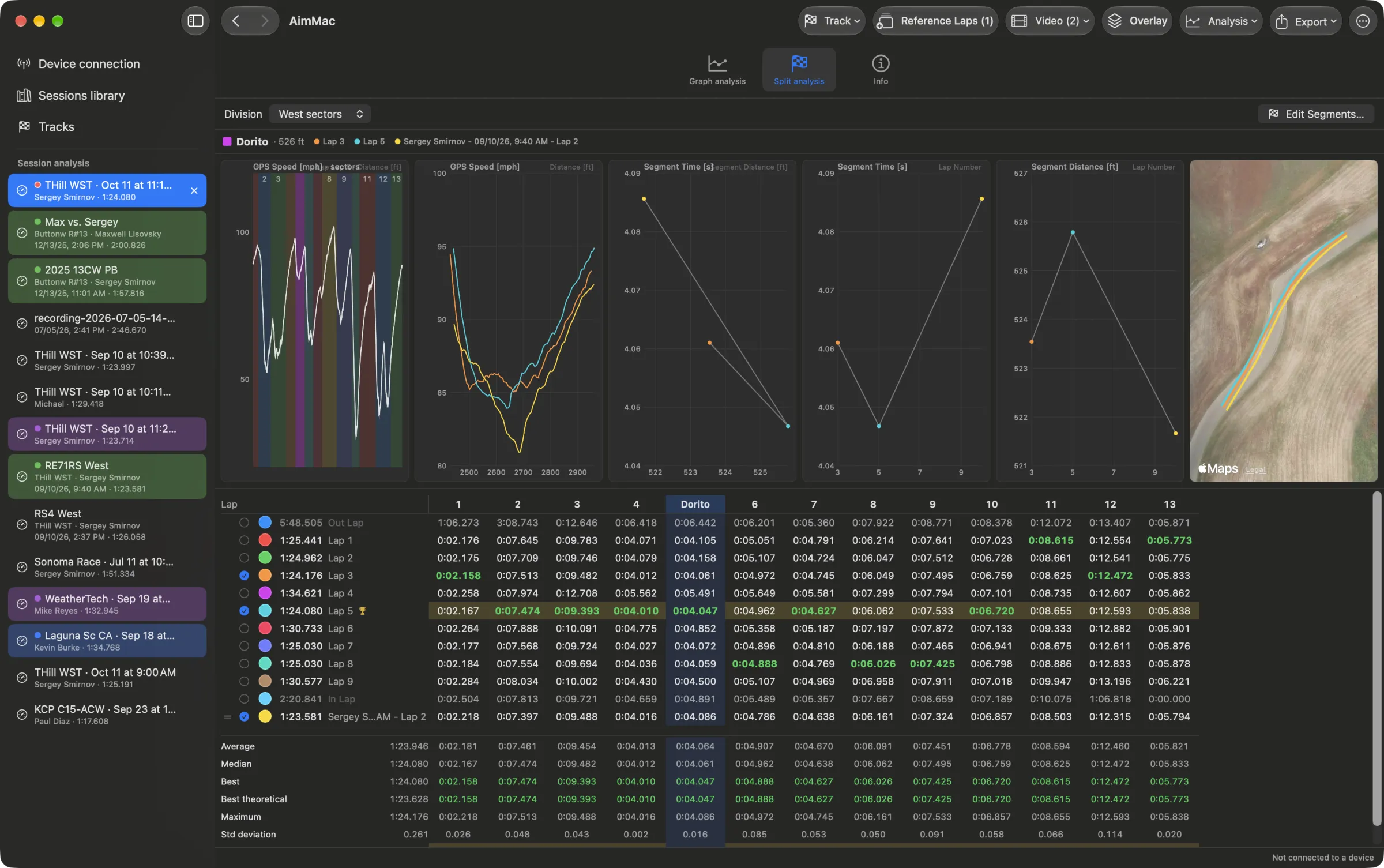
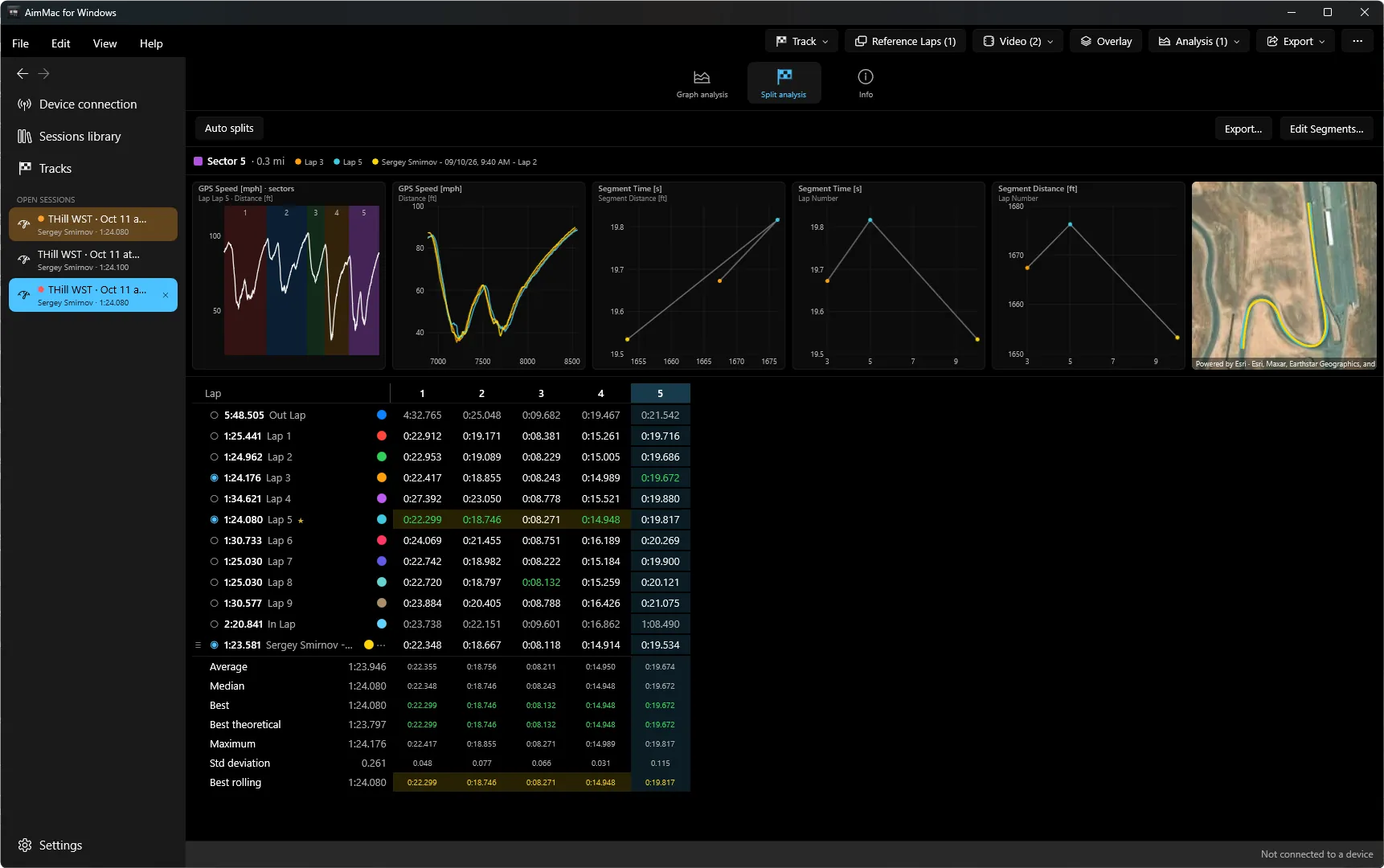
Split any lap into named sectors for times, deltas, a best-theoretical lap, and a best rolling stretch — the quickest run of consecutive splits anywhere in the session, wherever it happens to start.
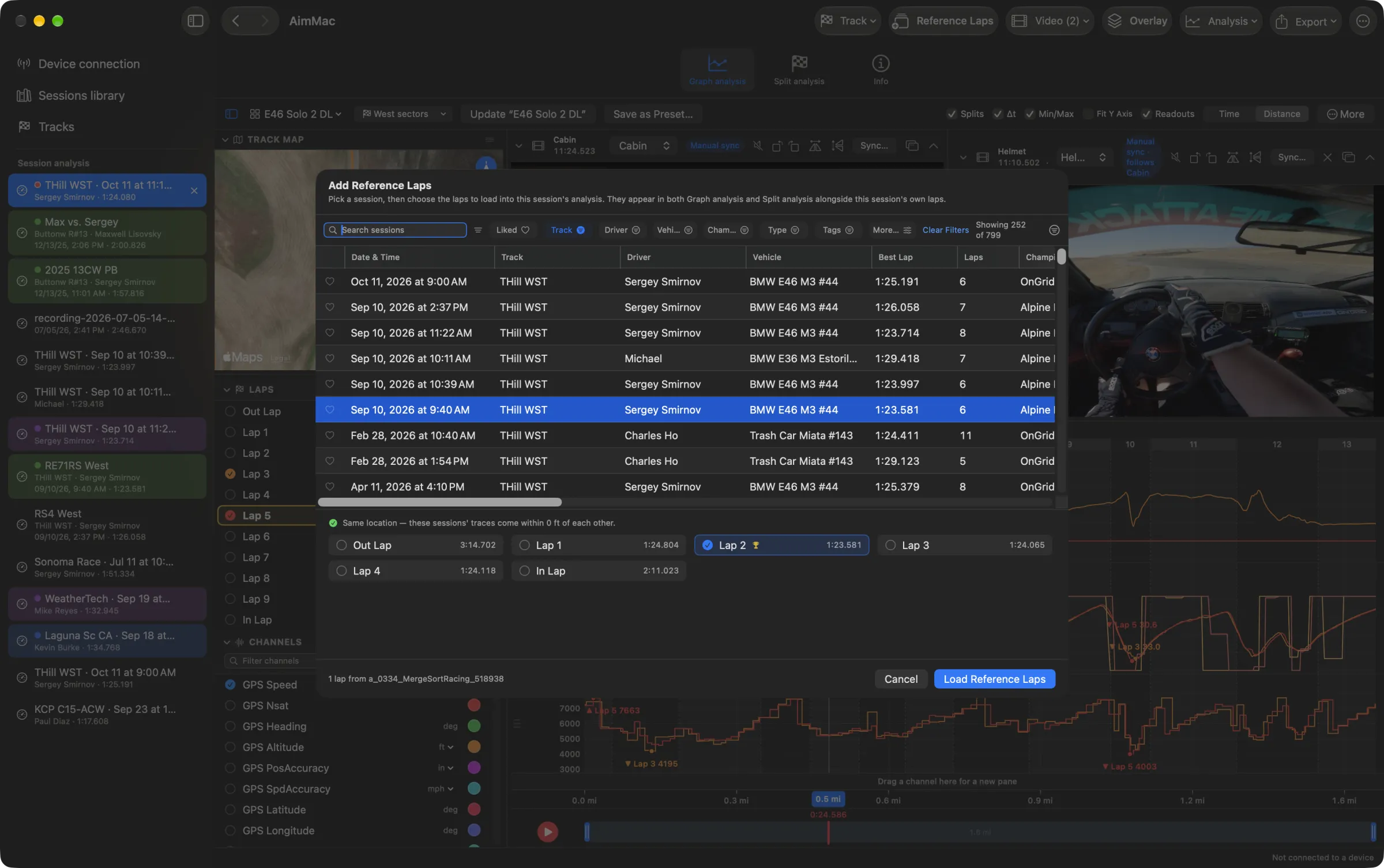
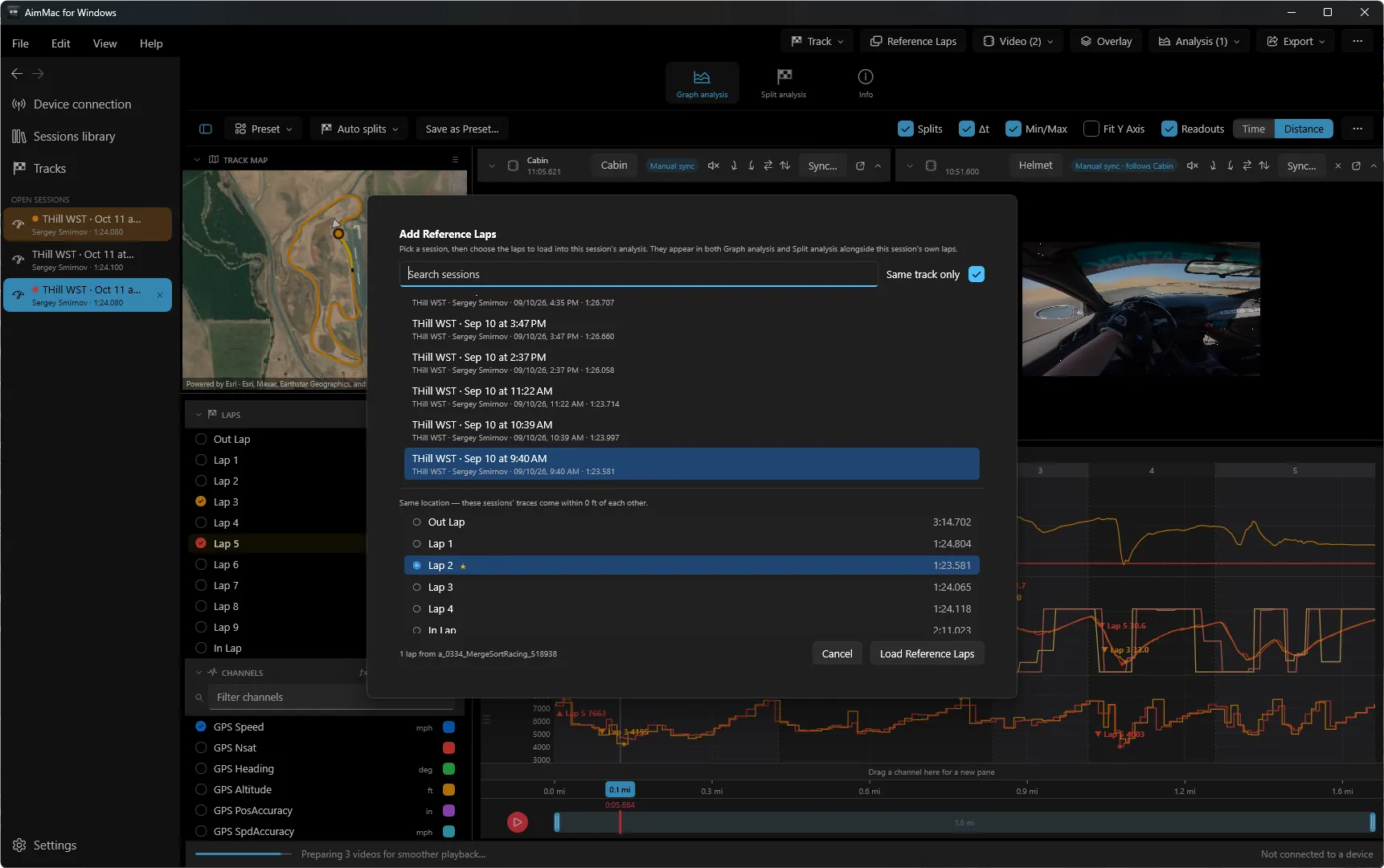
Pull a lap out of any other session — another day, another car, another driver, another logger entirely — and it behaves like one of this session's own laps everywhere: graph traces, the map, the split table. It even brings its own channels with it, so a session logging things this one doesn't still plots them.
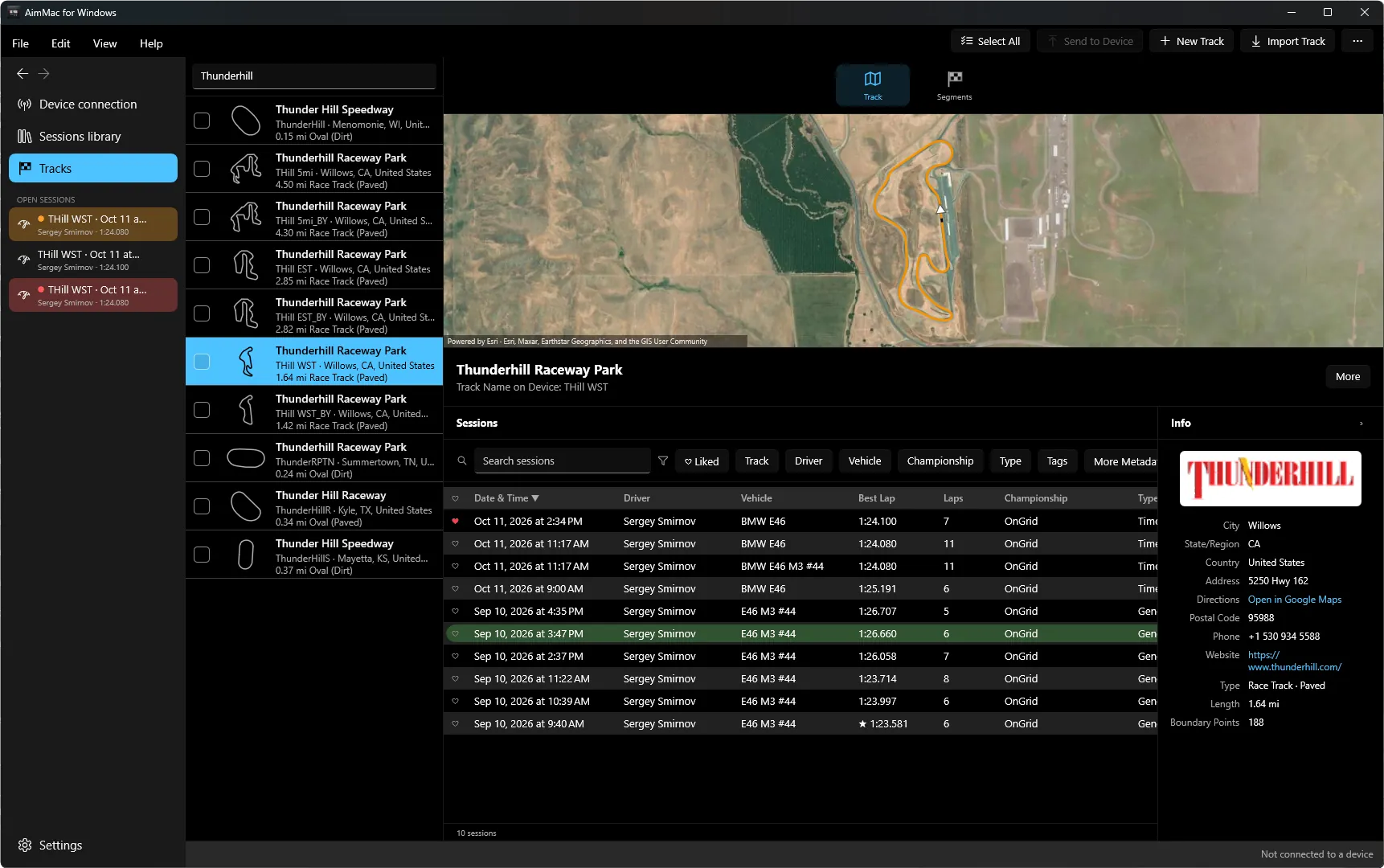
Sort, filter, favorite and color-label in a fast Finder-style table — down to tire compound, pressures, gearing, curb weight or track temperature. Bulk-edit, bulk-export, and merge the duplicates that come from importing the same run twice.
It isn't only for AiM sessions. VBOX, Harry's LapTimer, PB Buddy, RaceChrono, Dragy and other CSVs drop straight in and behave exactly like a session off your logger.
Weather, ambient and track temperature, tire compound and pressures, heat cycles, brake compounds, chain gearing, curb weight and ballast — recorded per session and filterable across the whole library later.
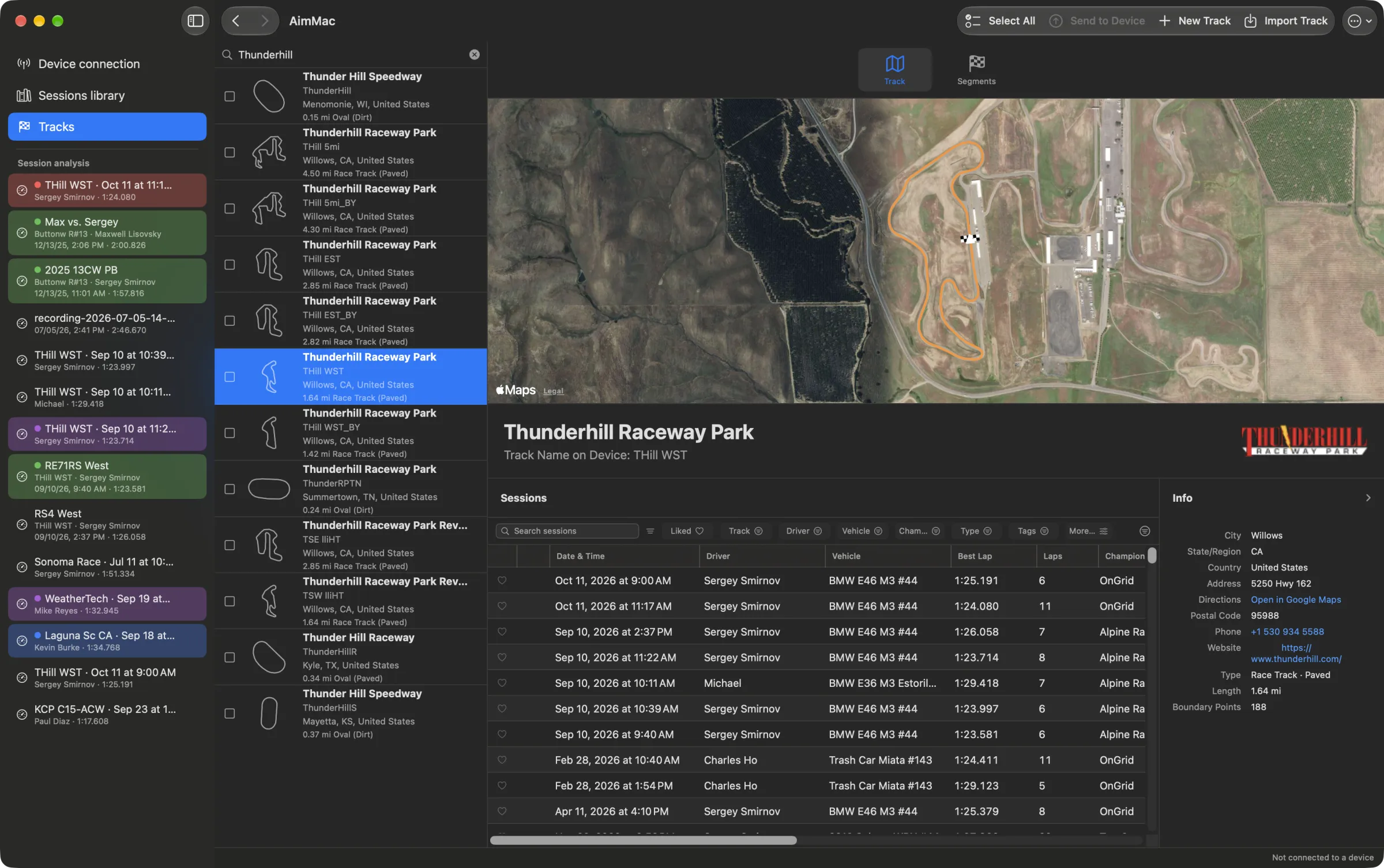
AiM's whole track database, your own sectors, and tracks you build yourself.
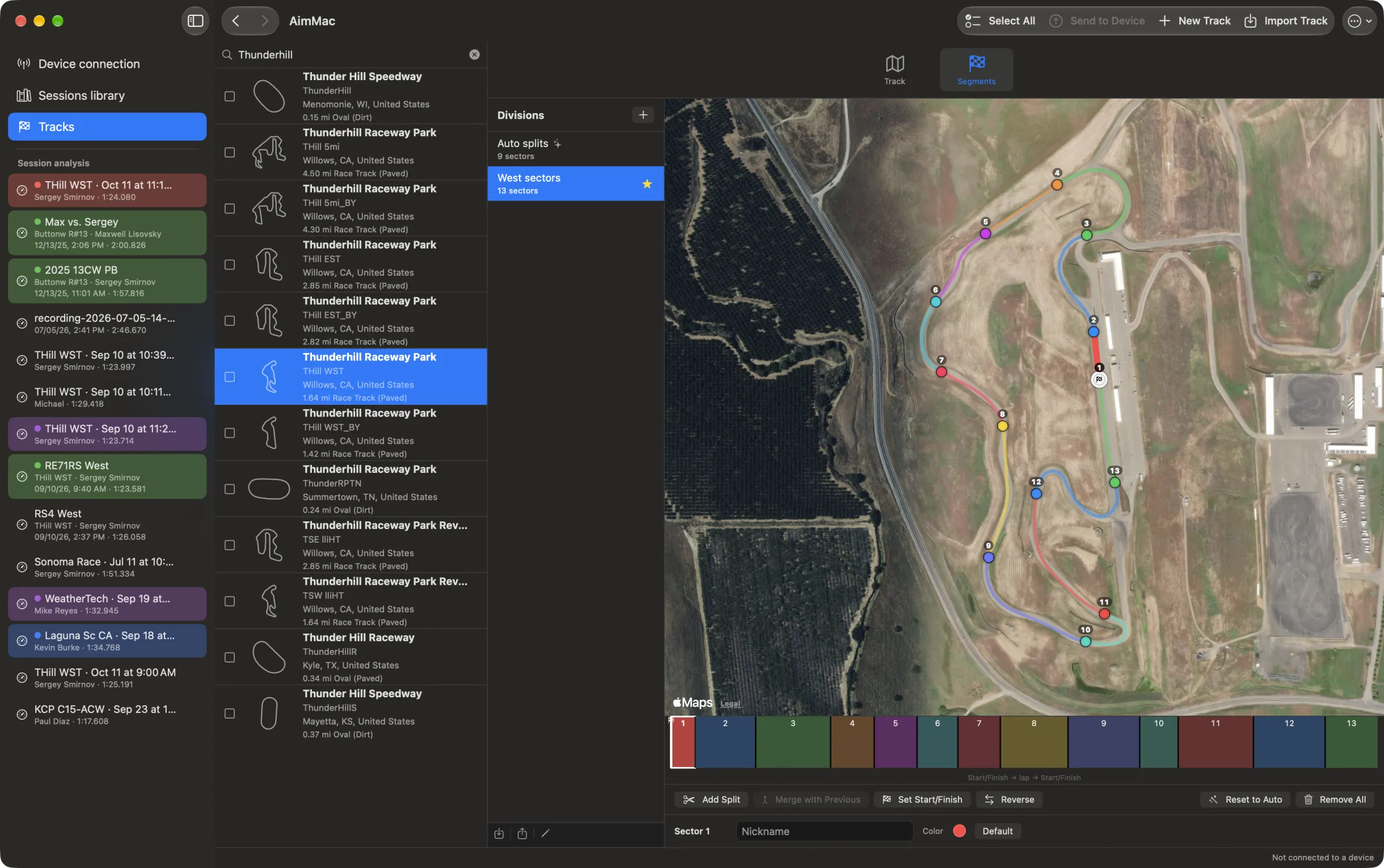
Search thousands of circuits and configurations, see each one's outline over satellite imagery, and jump straight from a track to every session you've run there.
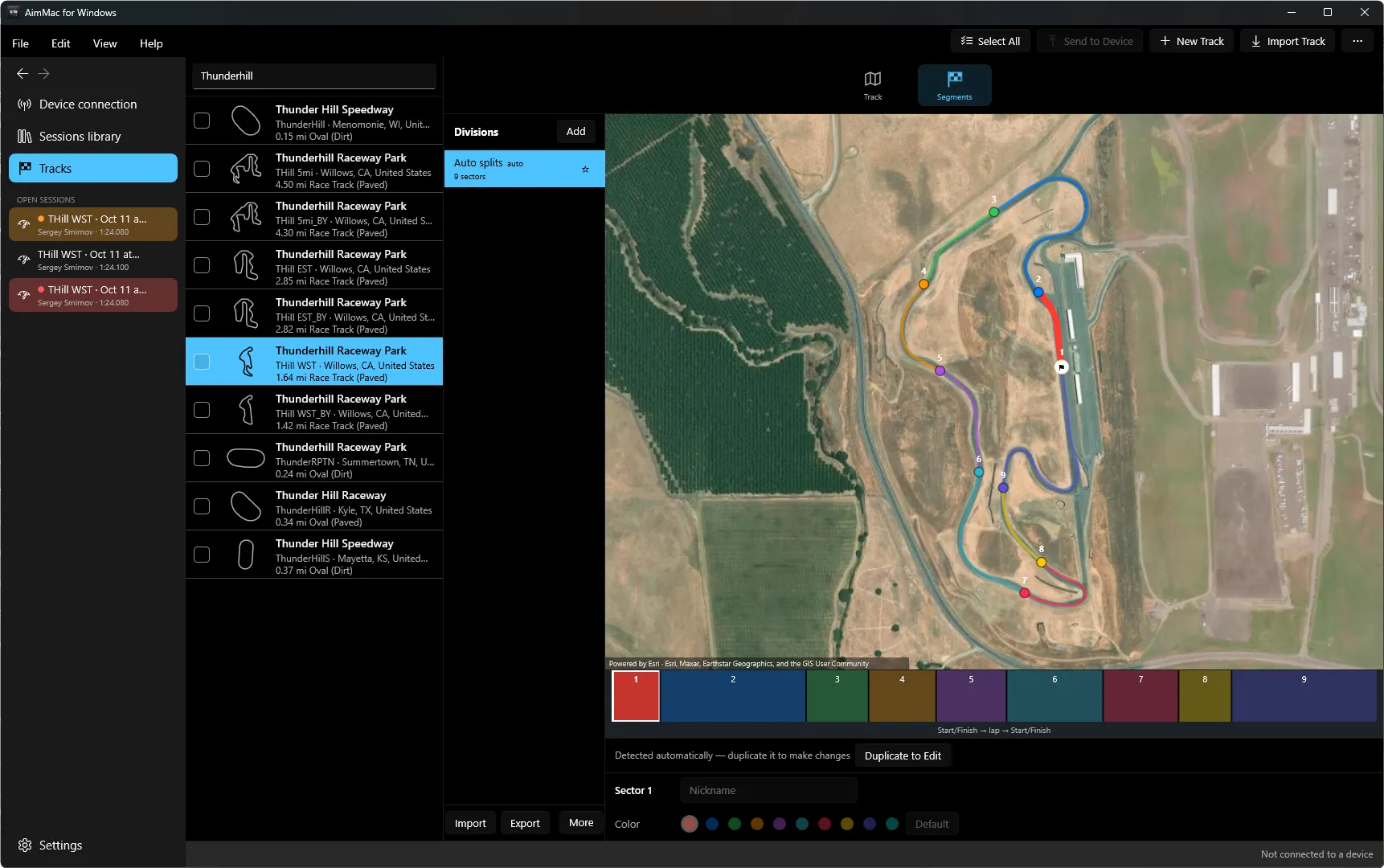
Split a track into as many named, colored sectors as you like by dragging them on the map. Save several divisions per track, star the one you want new sessions to open with, and import or export Race Studio's.
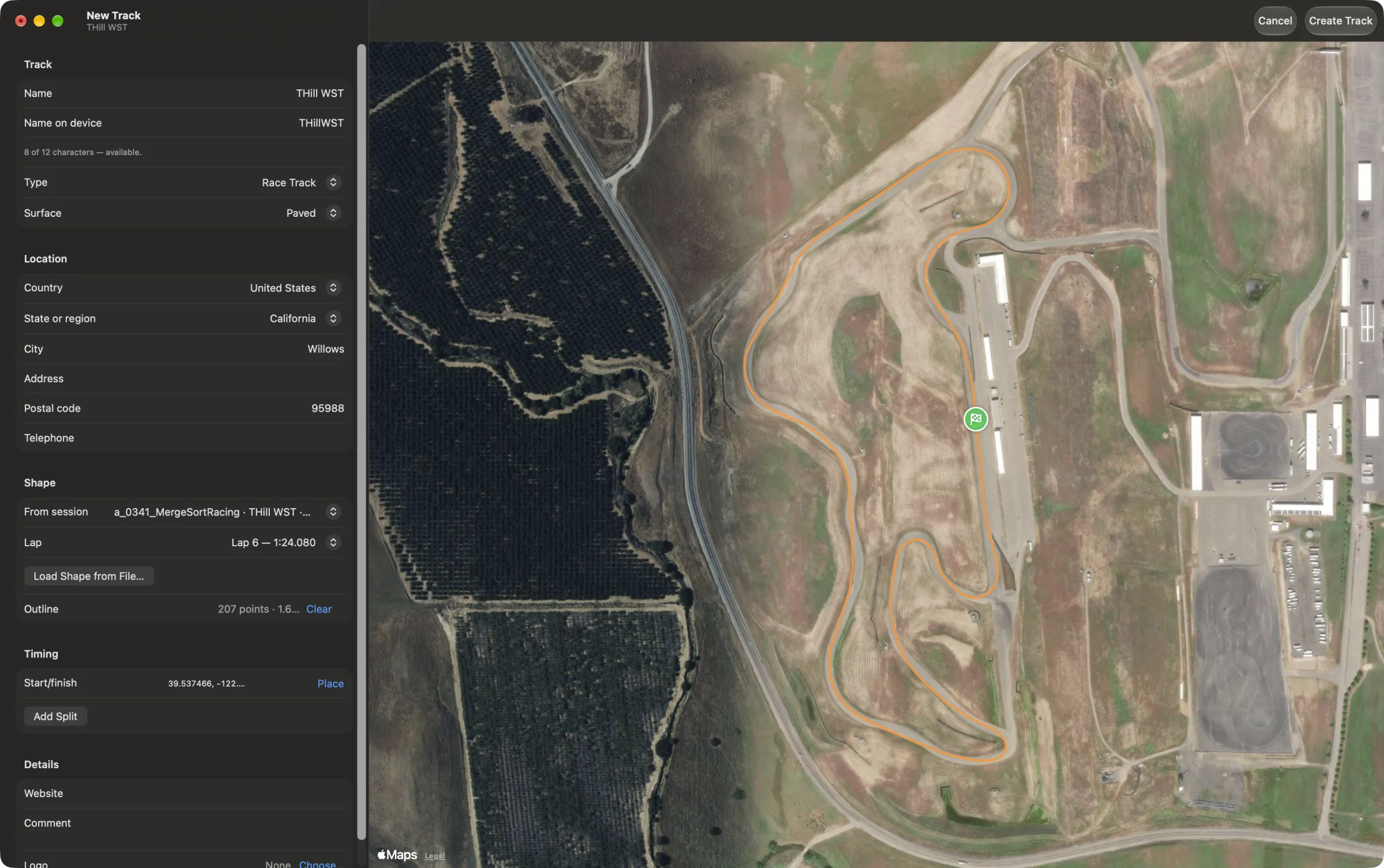
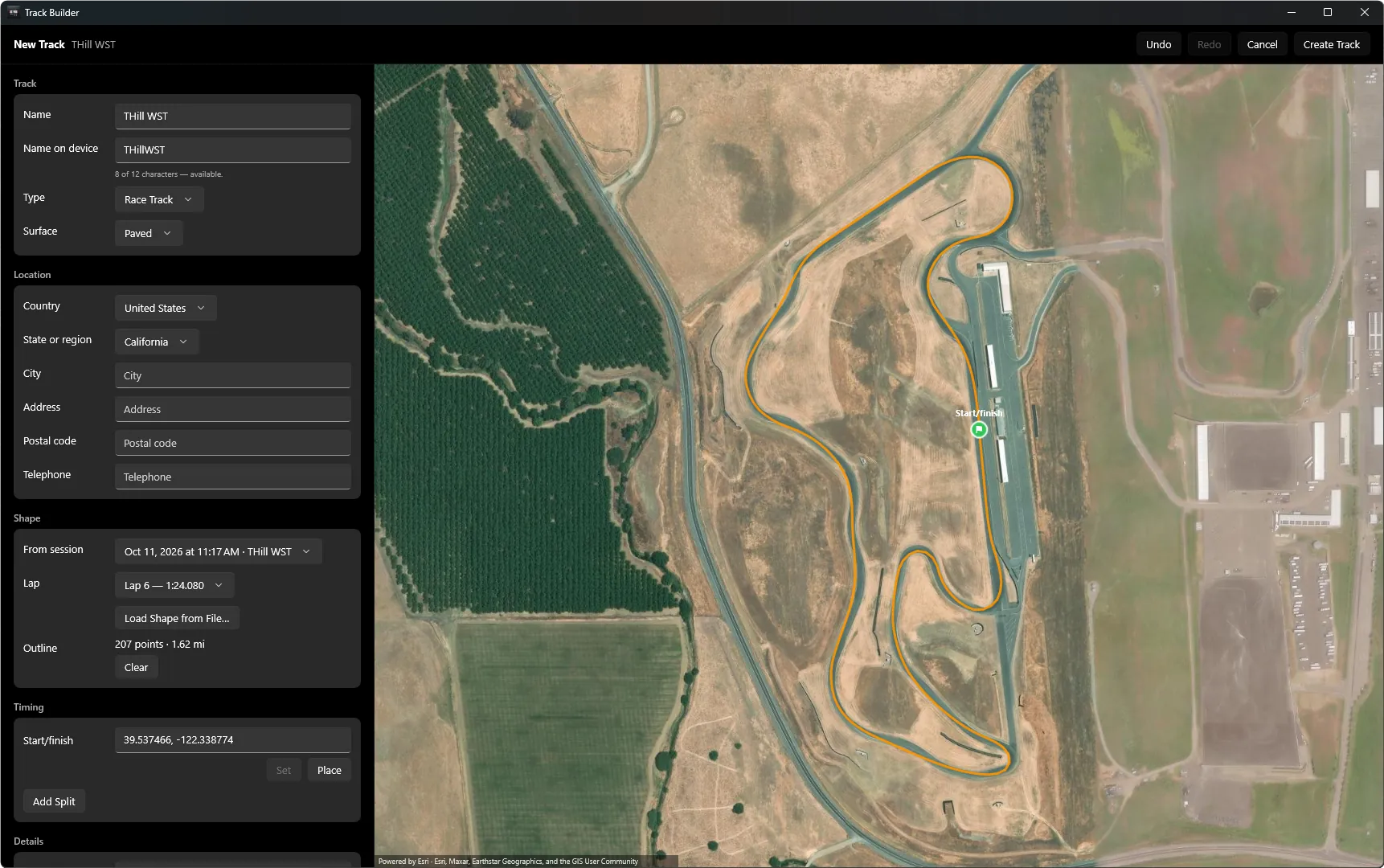
Trace a track from a single lap you drove — one clean lap, so the out-lap and the pit lane stay out of it — or from a KML, GPX or existing track file. Place the start/finish, add splits, fill in the location, and send it to the device. It's written in AiM's own format, so Race Studio reads it like any other track.
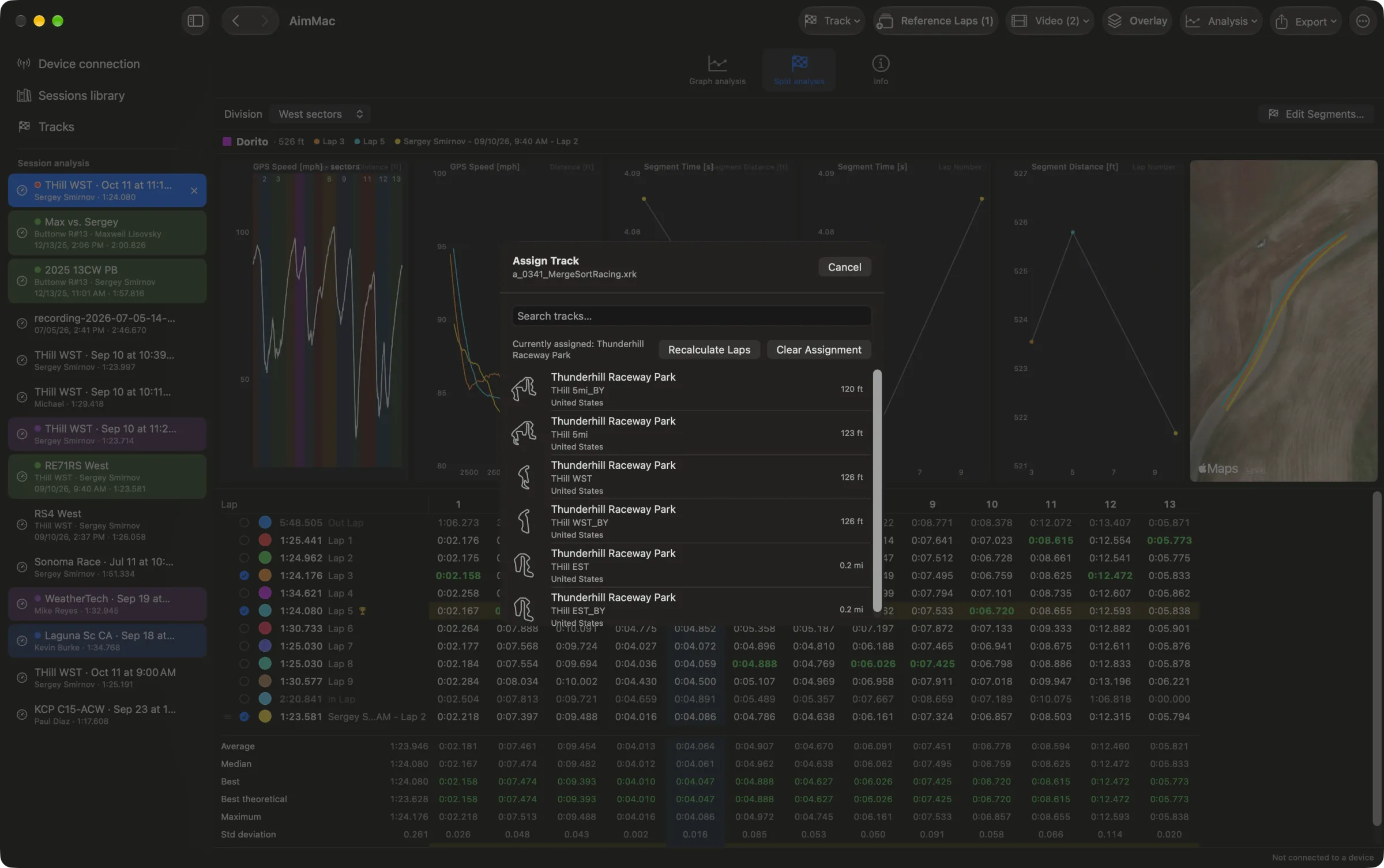
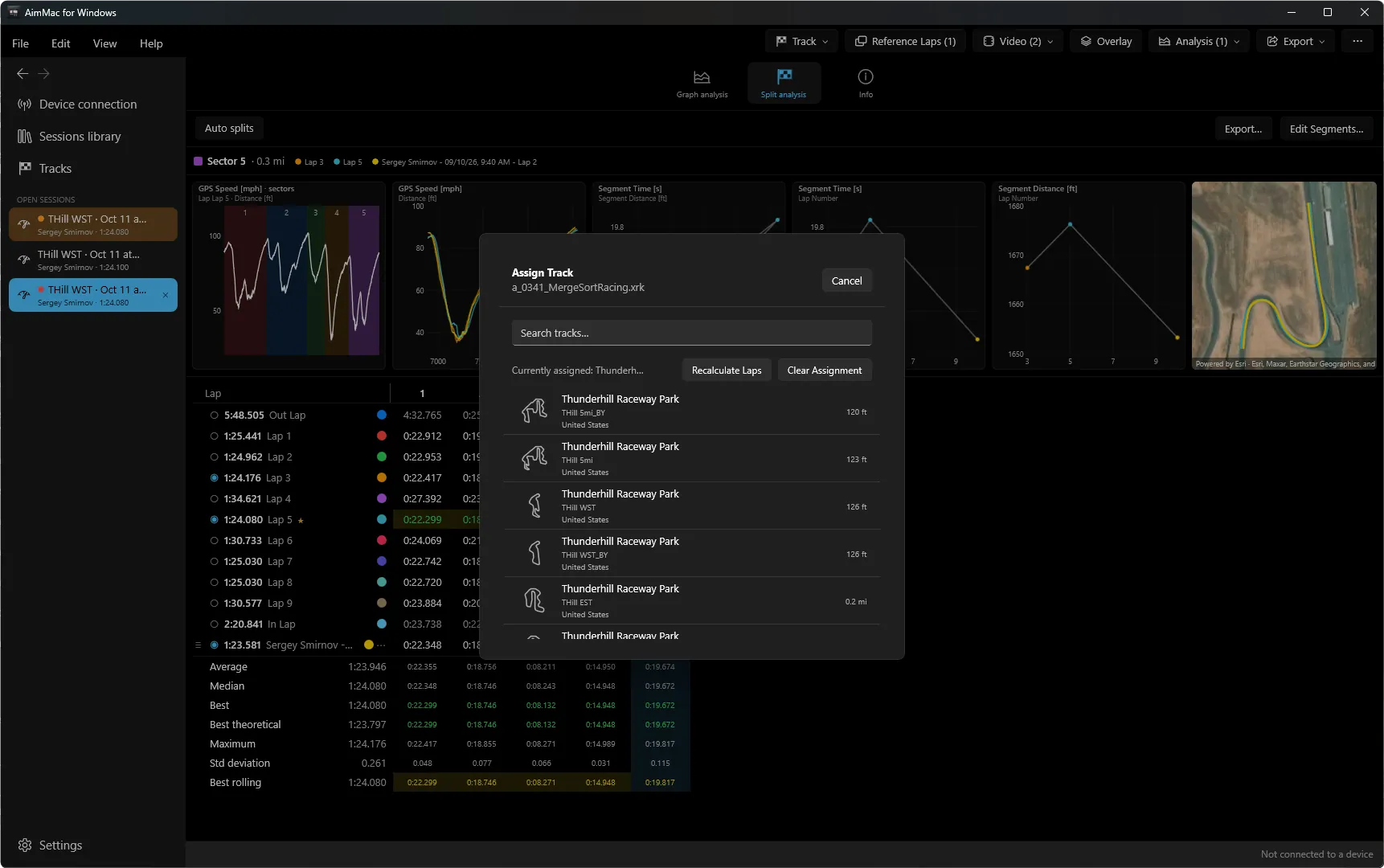
Sessions from loggers that record no laps at all get theirs worked out from the GPS trace. Assign the right track and AimMac snaps them to that venue's real start/finish — and you can recalculate or restore the recorded laps whenever you want.
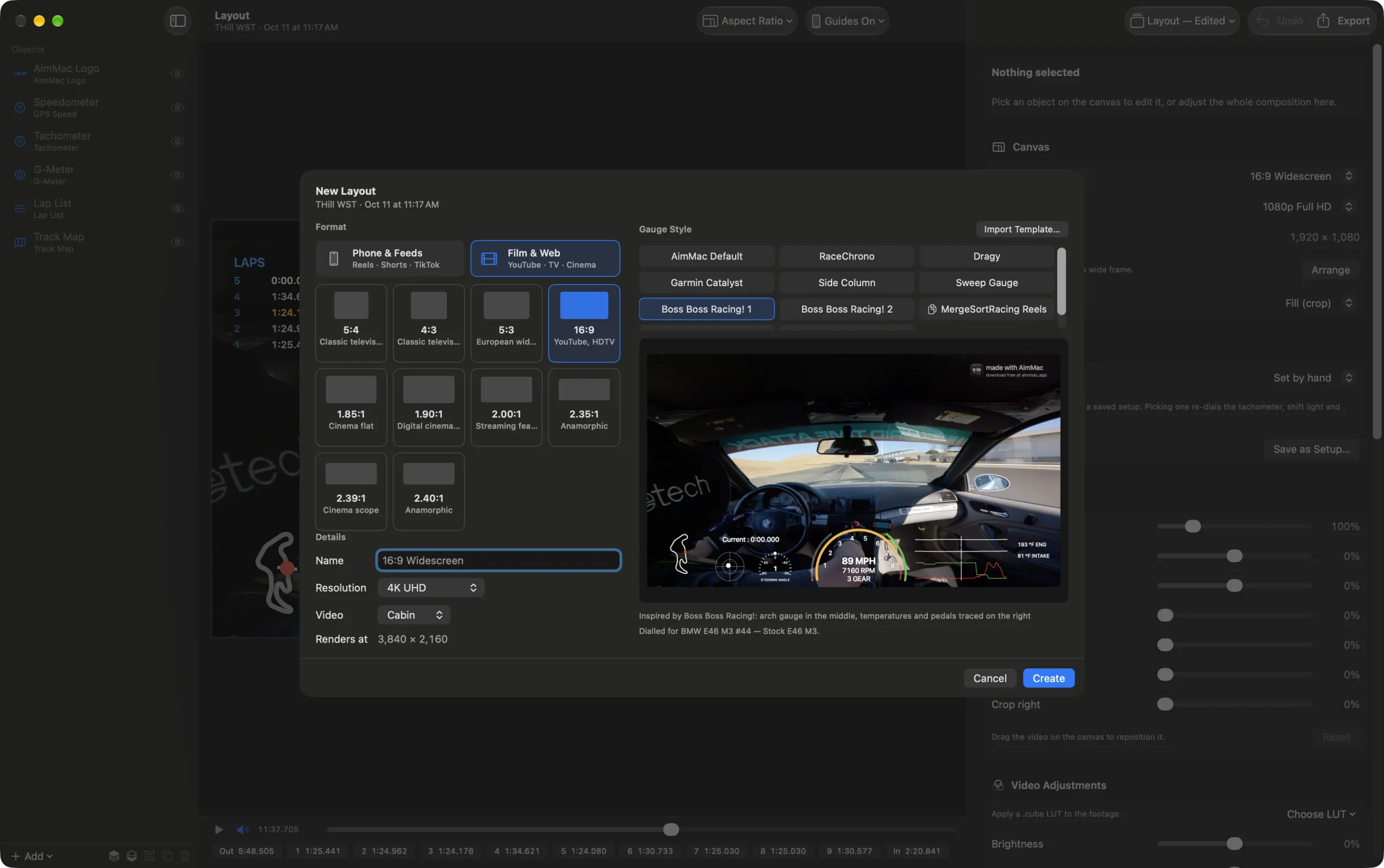
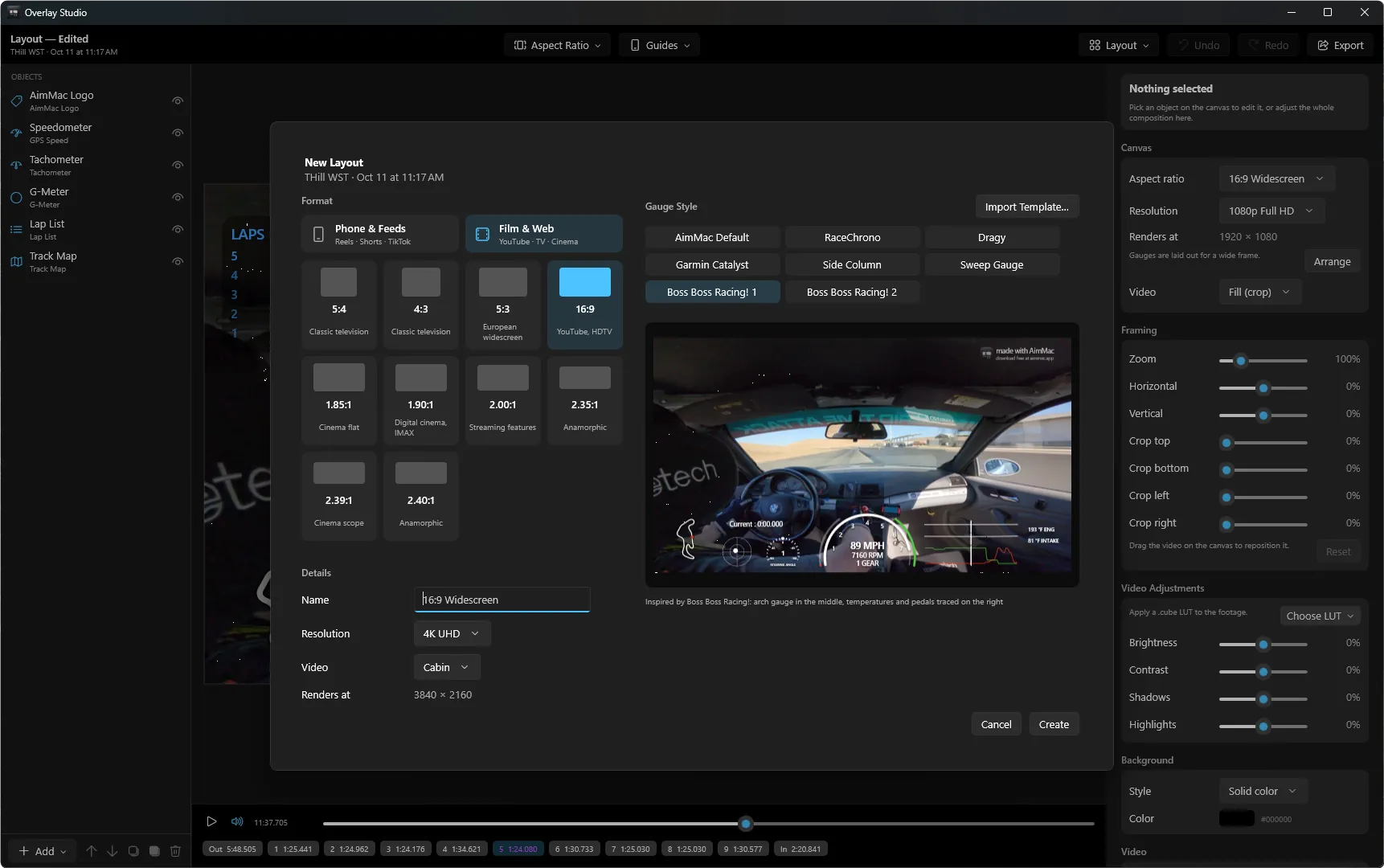
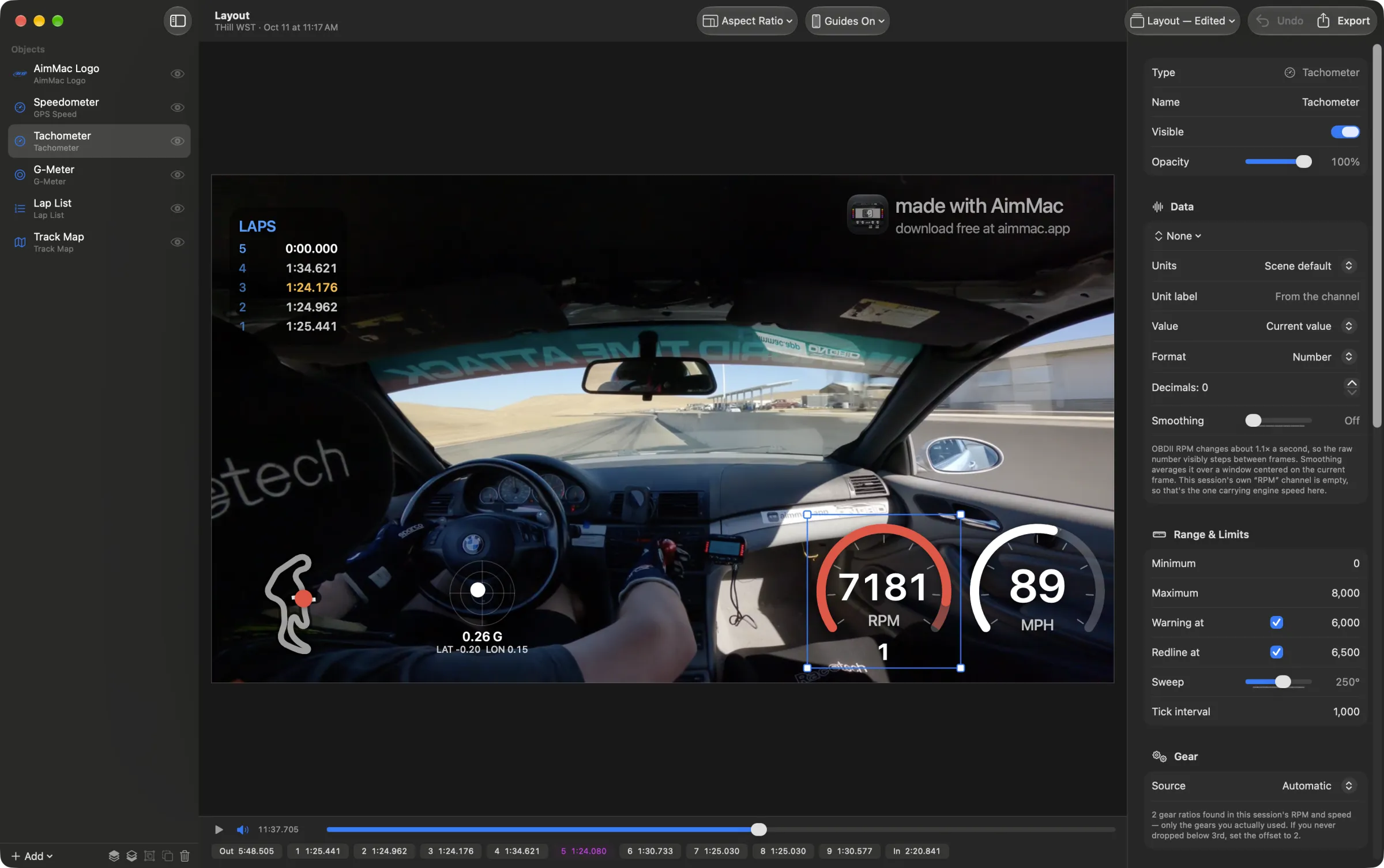
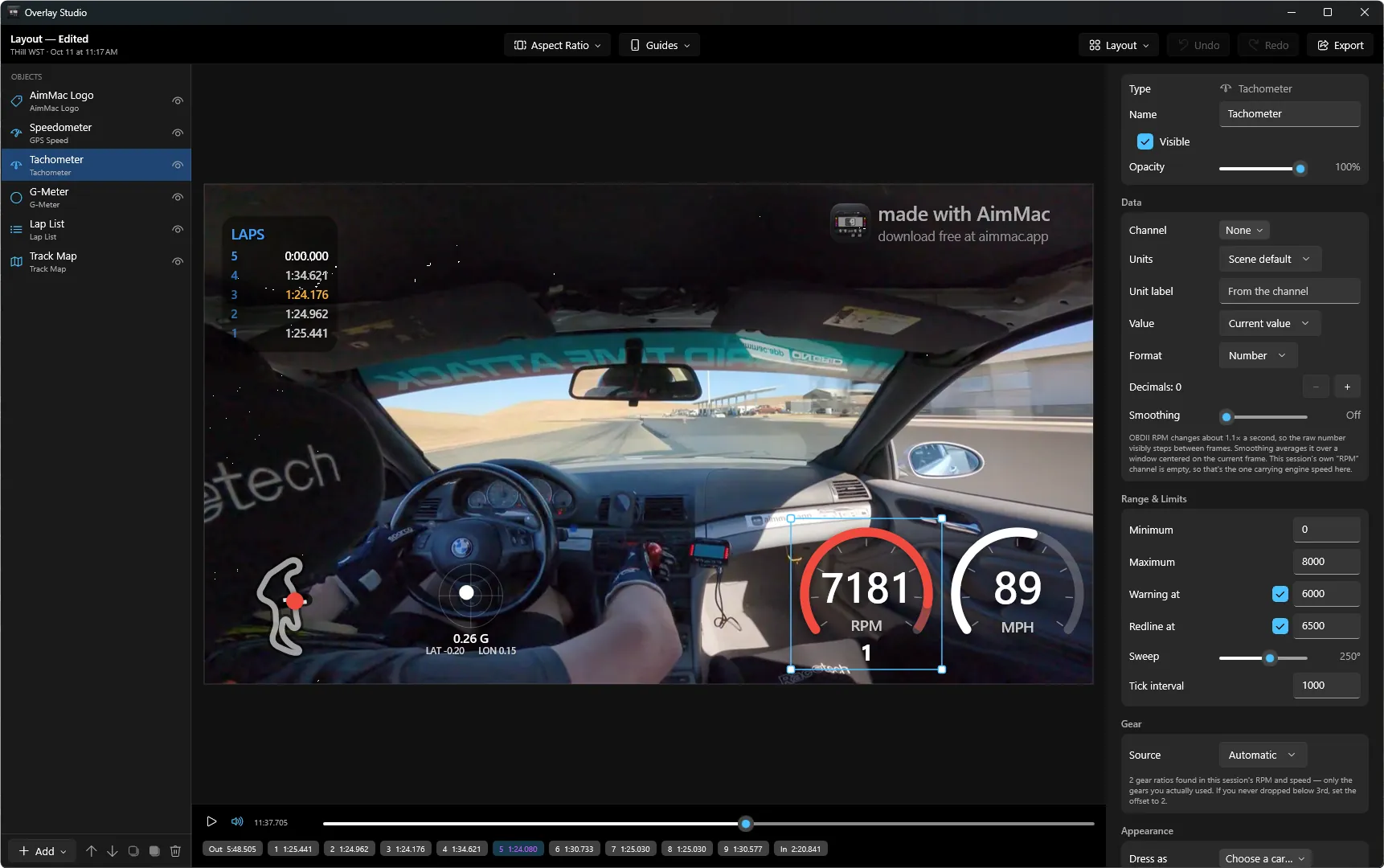
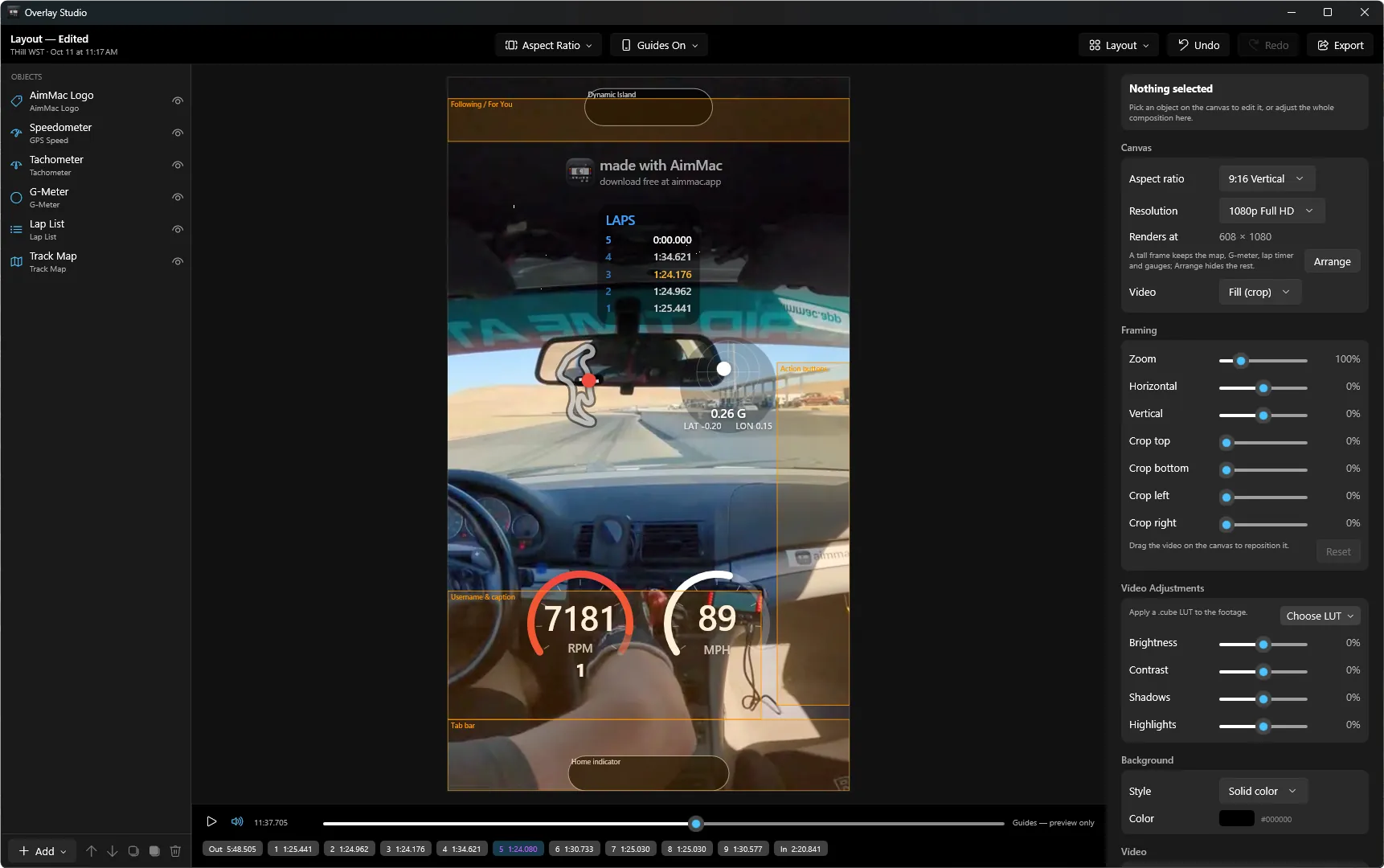
Link cabin, helmet and chase footage once — AimMac lines each one up against the session by itself — then compose gauges over it and render. No round trip through an editor.
Speedo, tach, G-meter, track map, lap times, shift lights, a steering wheel and more, laid out however you like and driven by the session itself. Gear and G-force get worked out even when nothing logged them.
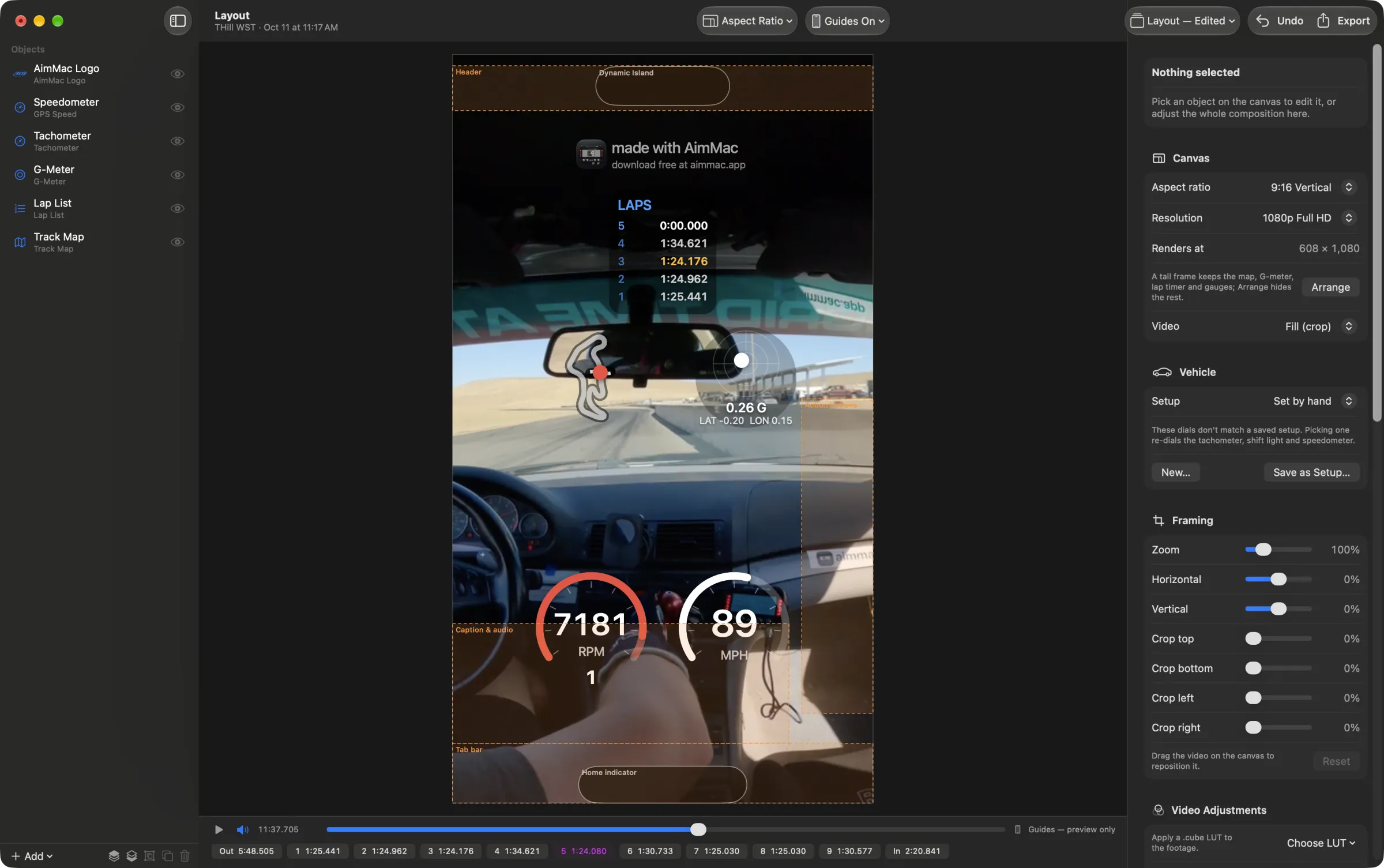
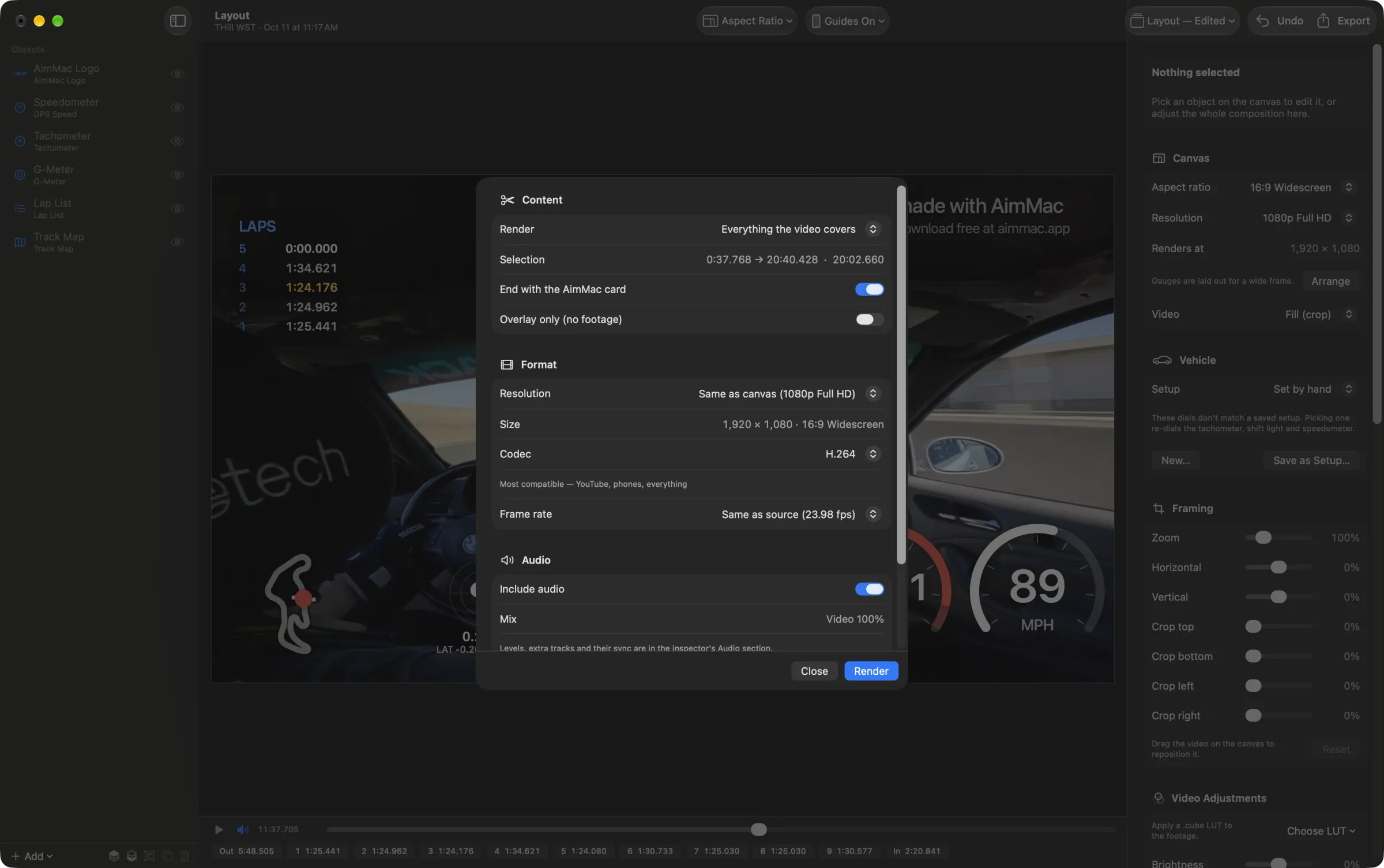
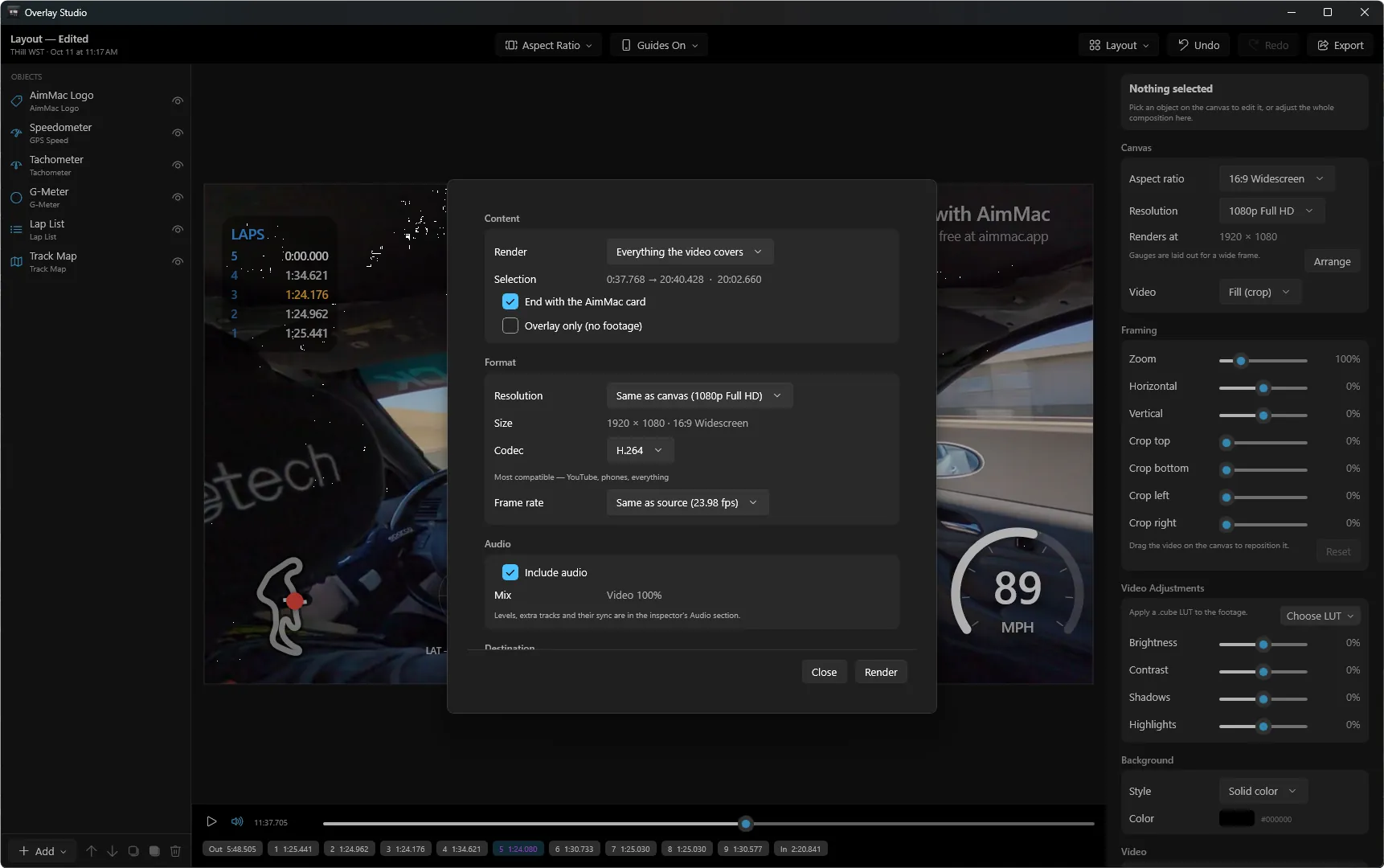
Compose 9:16 with guides showing where a phone's hardware and TikTok's or Reels' own buttons will land. Grade the footage with a .cube LUT, mix in a helmet mic or a second camera's audio, then render at up to 5K.
.xrk and .xrz, plus RaceStudio 2 (.drk), VBOX, RaceChrono, Dragy, Garmin FIT, Harry's LapTimer, GPX, NMEA, and CSV — including APEX Pro, PB Buddy, and any layout you map yourself.
Race Studio-compatible CSV, or a Racelogic VBOX file — your choice of channels, laps, sample rate and units, one session or a whole selection.
Point AimMac at a Race Studio 3 installation or a copied AIM_SPORT folder and it takes the sessions, tags, track splits and device artwork together.
Open as many sessions as you like, rename and color-label them, and drag any tab out into its own window.
Link as many recordings as you shot. Each keeps its own sync, and each brings its audio into the mix.
Save a graph layout or an overlay design once and reuse it on every session — or share it with someone else.
G-force from GPS when there's no accelerometer, plus steering, throttle and brake inferred from the data — so a car logging almost nothing still gets a full set.
A saveable report and an in-app packet capture, for when a logger misbehaves on a machine nobody else can see.
Signed and notarized — download, drag to Applications, go racing.